
What Becomes Possible When Your District's Systems Finally Work Together
Fragmentation, not a lack of tools, is the primary barrier to safer, more efficient school districts. Here's what to do about it.
Ask any K-12 superintendent what keeps them up at night and you'll hear variations of the same answer: safety, cybersecurity, aging infrastructure, and a budget that was never designed to handle all three at once. What you won't often hear, but what sits underneath all of it, is a more fundamental problem: the systems meant to address these challenges don't talk to each other.
Cameras operate on one platform. Access control on another. Transportation dispatchers work from a system the IT department has never logged into. The network security team monitors alerts that never reach the facilities manager running HVAC controls on the same infrastructure. Every system generates data. Almost none of it is shared.
This is fragmentation. And it's not a technology problem. It's a visibility problem.
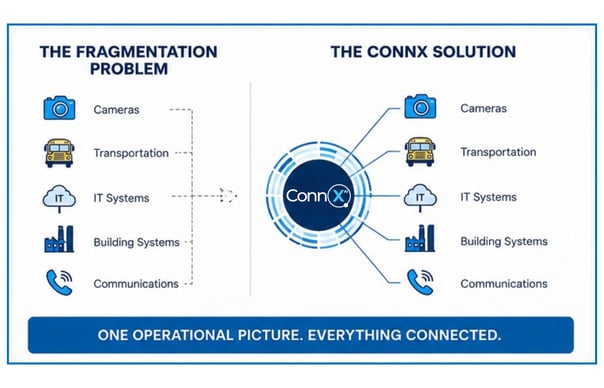
Figure 1: The Fragmentation Problem vs. The ConnX Solution — isolated systems unified through a single connective layer.
The data makes it concrete.
K-12 school districts are now one of the most targeted sectors for cyberattacks in the country. The scale is difficult to overstate.
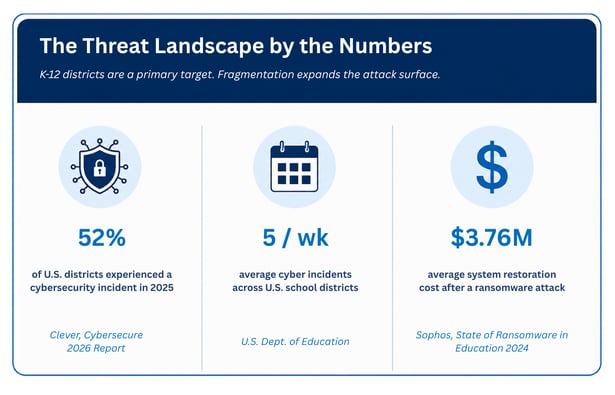
Figure 2: The Threat Landscape, By the Numbers — key cybersecurity statistics for K-12 districts.
According to Clever's Cybersecure 2026 Report, 52% of U.S. school districts experienced a cybersecurity incident in 2025 alone, up from 31% just two years earlier. The U.S. Department of Education reports an average of five incidents per week across districts nationwide. The average cost to restore systems after a ransomware attack, excluding the ransom itself, is $3.76 million.
But here's what those numbers don't fully capture: a cyberattack on a school district is no longer just a data breach. When IT and operational technology share the same network infrastructure, and in modern districts, they almost always do, a breach can cascade into physical safety systems, HVAC controls, communications platforms, and transportation operations. The attack surface isn't the firewall. It's the entire connected environment.
And that environment, in most districts, was never designed to be monitored as a whole.
.png?width=659&height=118&name=Pull%20Quote%201400x250%20(2).png)
"The districts most exposed aren't the ones with the least technology. They're the ones with the most — and no way to see it all at once."
More tools haven't solved it. A unified layer can.
When a new challenge appears, a state mandate on panic alert systems, a board resolution on cybersecurity, a grant opportunity for fleet GPS, the instinctive response is to find a product that addresses it. Over time, the average district accumulates dozens of these point solutions. During the 2024-25 school year, districts accessed an average of 2,982 different ed tech tools, a nearly 9% increase from the prior year.
Each tool solves something. None of them solves fragmentation. That requires a different approach: instead of adding to the stack, connect it.
A unified operational layer doesn't replace the systems a district already owns. It integrates them, creating a single operational picture where data from cameras, access control, transportation platforms, IT monitoring, OT sensors, and communications can be seen, correlated, and acted on together. When a panic button activates in a classroom, that event shouldn't require four phone calls to coordinate a response. It should automatically trigger the right communications, initiate lockdown protocols, and alert first responders, with no manual relay between disconnected systems.
What this looks like in practice.
Unified visibility isn't abstract. Across the six operational areas that matter most to district leaders, it produces concrete, measurable outcomes:
- Emergency response — coordinated alerts, automated lockdown workflows, and real-time situational dashboards replace manual phone trees and delayed coordination.
- Transportation — fleet location and driver communications connect to the district operations center, so a lockdown immediately reaches dispatch — not three calls later.
- Facilities — HVAC, energy, and access control data flow into a single view, enabling predictive maintenance rather than reactive repairs.
- Cybersecurity — IT and OT are monitored as a single environment, applying Zero Trust principles across the full attack surface rather than two separate silos.
- Communications — voice, messaging, mass notification, and paging connect across every campus, with geo-fenced alerts reaching the right people in the right locations.
- Leadership decisions — a single operational picture replaces fragmented reports, enabling faster, better-informed decisions across every function of the district.
The roadmap is more accessible than you think.
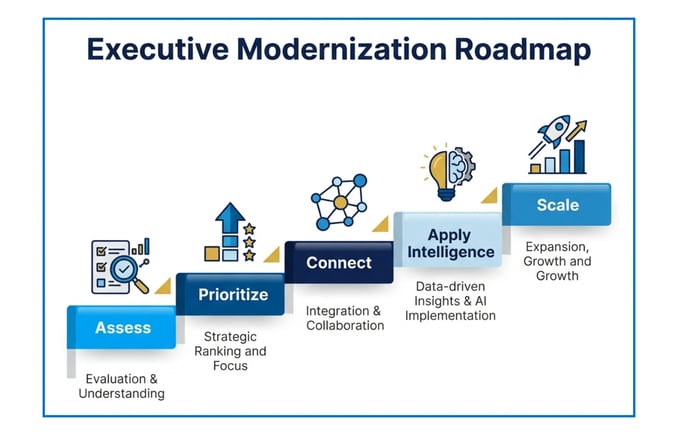
The most common objection to this kind of modernization is budget. But the path doesn't start with a capital project. It starts with an assessment. What do you already own? Where are the most significant visibility gaps? Which gaps carry the highest safety and operational risk?
From there, a phased approach connects existing systems incrementally, beginning with the highest-priority areas and building out over time. Each phase delivers value immediately. And because the approach connects rather than replaces, it protects prior investments instead of discarding them.
Funding is also more available than most district leaders realize. The FCC's E-Rate program covers Category 2 network infrastructure investments, precisely the foundation a unified operational layer requires. The FCC's $200M Schools and Libraries Cybersecurity Pilot Program funded eligible cybersecurity services and equipment for hundreds of institutions, and the program's demand ($3.7 billion in requests for $200 million in funding) is driving policy conversations about expanding cybersecurity as a standard E-Rate category.
.png?width=679&height=121&name=Pull%20Quote%201400x250%20(1).png)
Start with visibility, not procurement. The highest-impact improvements are often achievable by connecting what you already own.
Actionable Intelligence amplifies a unified foundation.
Connecting a district's systems does more than close visibility gaps. It creates the foundation for actionable intelligence: using unified data to surface anomalies earlier, flag equipment issues before they escalate, and support faster, better-informed decisions across every operational area.
But intelligence is only as good as the data behind it. A tool analyzing one system in isolation offers limited value. Applied across a fully connected environment, the same capability becomes far more useful. That's why infrastructure integration comes first. The unified layer is the foundation. Actionable intelligence is what it enables.
Districts that invest in connecting their existing systems now are building the foundation for smarter, faster decision-making across every part of their operation.
Ready to see what unified infrastructure looks like for your district?
Explore ConnX solutions at https://connxai.com/solutions-campus-workplace-safety
___________________________________________________________________________________________________________________________________

For those beginning this process, starting with a structured assessment can provide a clear and manageable path forward:
Explore our ConnX Assessments and get started today on the path to clarity!

.png)