
.png?width=1200&length=1200&name=What%20you%20cant%20see%20will%20disrupt%20you%20-%20Graphic%20(1).png)
When Connectivity Is Disrupted: What the Verizon Outage Reinforces About Modern Resilience
Connectivity is foundational to modern operations, yet often invisible when it’s working, and immediately consequential when it’s not.
Earlier this month, a service disruption affecting portions of Verizon’s network impacted voice and data connectivity for customers across several regions. While service was restored, the event highlighted a broader reality facing organizations today: critical operations depend on complex, interconnected infrastructure that spans networks, communications platforms, cloud services, and operational systems.
While moments like these tend to draw attention to the disruption itself, the more valuable conversation happens afterward when organizations step back and examine what these events reveal about preparedness, visibility, and resilience in an increasingly connected world.
In many cases, the greatest challenge isn’t the disruption alone, but the fragmentation that exists across systems, tools, and teams. When visibility is scattered and information lives in silos, understanding impact and coordinating response becomes harder than it needs to be—especially in environments that span networks, communications, cloud, and operations.
Outages Are Signals, Not the Root Problem
Large-scale disruptions are rarely the result of a single failure in isolation. More often, they expose interdependencies that are difficult to see until conditions change.
Modern organizations operate across:
-
Carrier and network infrastructure
-
Communications and voice platforms
-
Cloud and hybrid environments
-
Identity and access systems
-
Integrated applications and operational technologies
When one part of this ecosystem is strained, the effects can ripple quickly, impacting communications, workflows, customer experience, and operational coordination.
The issue isn’t simply preventing disruption. It’s understanding how systems depend on one another and how impact propagates when visibility is fragmented.
Why Reactive Response Is No Longer Enough
Traditional resilience strategies have focused heavily on recovery: how quickly services can be restored after an issue is identified. While recovery remains important, it is no longer sufficient on its own.
In highly interconnected environments, reactive response often looks like:
-
Alerts without sufficient context
-
Manual correlation across disconnected tools
-
Teams working in parallel without a shared operational picture
-
Delayed understanding of downstream impact
These challenges are often less about technology failure and more about fragmented visibility and disconnected decision-making across the organization. When teams lack a common view of what’s happening, response slows at the moment speed and clarity matter most.
As infrastructure grows more complex, resilience must shift upstream from reactive troubleshooting to proactive preparedness.
Proactive Resilience Starts with Visibility
At the heart of modern resilience is visibility—but not visibility in the narrow sense of dashboards or isolated monitoring tools.
Proactive organizations focus on end-to-end visibility that provides:
-
Insight across networks, communications, cloud, and operations
-
Understanding of how systems and services interact
-
Context that turns raw signals into actionable insight
This level of visibility reduces fragmentation by giving teams a shared understanding of impact, enabling faster prioritization and more confident action before disruption escalates.
Visibility, in this sense, becomes a decision-making advantage, not just a technical capability.
From Isolated Signals to Shared Intelligence
Visibility alone isn’t enough. Signals must be correlated, contextualized, and shared across teams.
Resilient organizations invest in shared intelligence that:
-
Reduces noise by correlating related events
-
Surfaces leading indicators rather than lagging symptoms
-
Aligns IT, communications, security, and operations around a common operational picture
When teams operate from the same understanding, response becomes coordinated instead of improvised. Fragmentation gives way to alignment, and decisions become faster and more effective under pressure.
This is especially critical in environments where responsibility spans multiple domains, tools, and stakeholders.
Designing for Continuity, Not Just Recovery
Another hallmark of proactive resilience is designing for continuity rather than assuming full availability at all times.
This includes:
-
Automated failover and traffic re-routing
-
Graceful-degradation modes that preserve critical services
-
Pre-approved response workflows that reduce reliance on manual intervention
These capabilities allow organizations to maintain stability even when conditions change. Resilience becomes something that is built into operations, not assembled in the moment.
Resilience, in this sense, is not a one-time configuration but an operational discipline.
How ConnX Helps Organizations Prepare
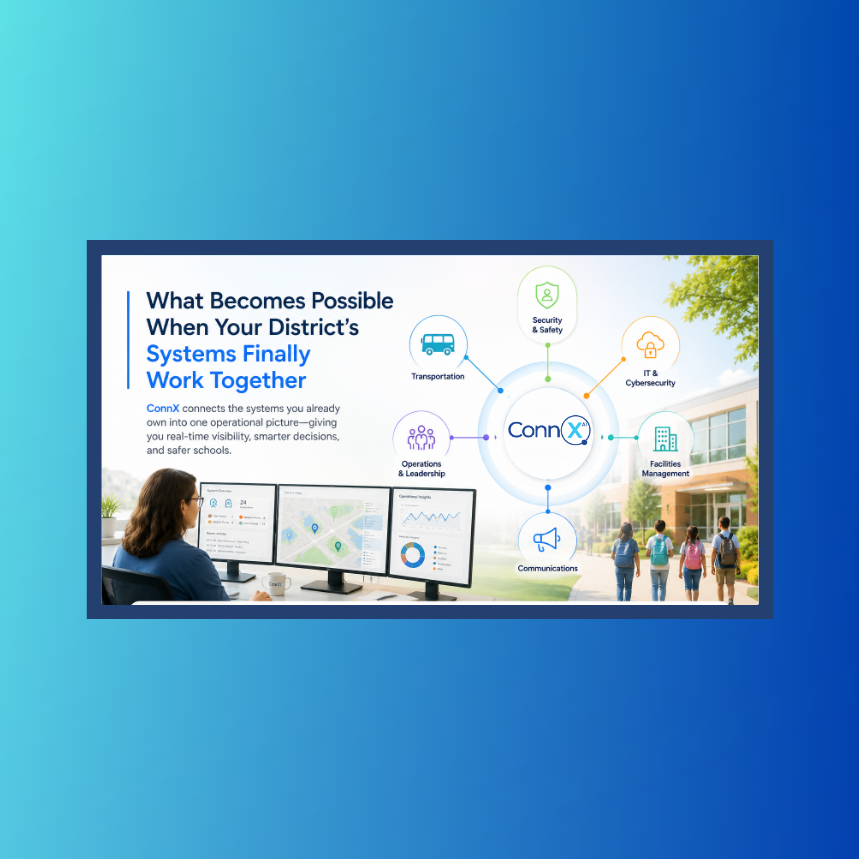
ConnX helps organizations address fragmentation by delivering a shared intelligence layer that connects infrastructure, communications, and operational systems.
Through platforms like MaestroIQ, supported by SecurityIQ and IntegrationWorks, ConnX enables:
-
Unified visibility across complex environments
-
Predictive insight into emerging risks
-
Automated continuity and coordinated response
-
Governance-ready reporting for operational and security leaders
Rather than replacing existing investments, ConnX brings them together, turning disconnected systems and data into actionable intelligence.
Looking Ahead
Disruptions, whether driven by connectivity, infrastructure, or system complexity, will continue to occur as environments evolve.
The organizations best positioned to navigate them are those that focus less on the event itself and more on what it reveals about visibility, coordination, and fragmentation across their operations.
Resilience isn’t about eliminating disruption altogether.
It’s about being prepared to understand impact, align response, and act with confidence no matter the circumstances.
ConnX Infrastructure & Connectivity Resilience Framework & Checklist:
Modern operations depend on interconnected infrastructure, networks, and communications systems working together seamlessly. When visibility is limited, even minor disruptions can quickly escalate across teams and services. To help organizations move from reactive response to proactive readiness, we’ve created the ConnX Infrastructure & Connectivity Resilience Framework & Checklist—an executive-ready resource that outlines the core capabilities needed to improve visibility, uncover hidden dependencies, and strengthen continuity across complex environments.
👉 Download the Framework & Checklist to assess your organization’s resilience readiness and build a stronger foundation for proactive infrastructure and connectivity resilience: